WELCOME TO GIG PERFORMER®
Own The Stage®
Scaling curves allow you to control the shape of the output of a widget or convert an incoming note velocity to a new velocity. Various predefined curves are available and they can be tweaked as necessary. You can also just draw your own curve as well to achieve the effect you require.
Create a sound by placing and interconnecting your desired plugins, such as a synth, some effects and perhaps a mixer. Select them all and then save the selection as a named favorite. The favorite will subsequently show up in all plugin insert menus, making it easy for you to recreate that configuration whenever you need it again. This feature is also very powerful for creating your needed sounds on your studio computer and then transferring them to your touring laptop.
Parameters you select in an open plugin are captured into the Probabilistic Sound Designer dialog window. When you click Randomize, you're only adjusting those selected parameters. Each entry in the PSD dialog has a curve but unlike widgets where the curve controls scaling, in the PSD the curves are used to define the probability of particular values being selected. Make sure the filter cutoff never gets too slow so as to block all sound. Perhaps adjust the max range of the VCA attack parameter so that the sound doesn't have too much delay. Constrain the octave ranges of the oscillators, perhaps ensuring that 1/3rd of the time we select 8' and 2/3rds of the time we select 4'. The possibilities are endless.
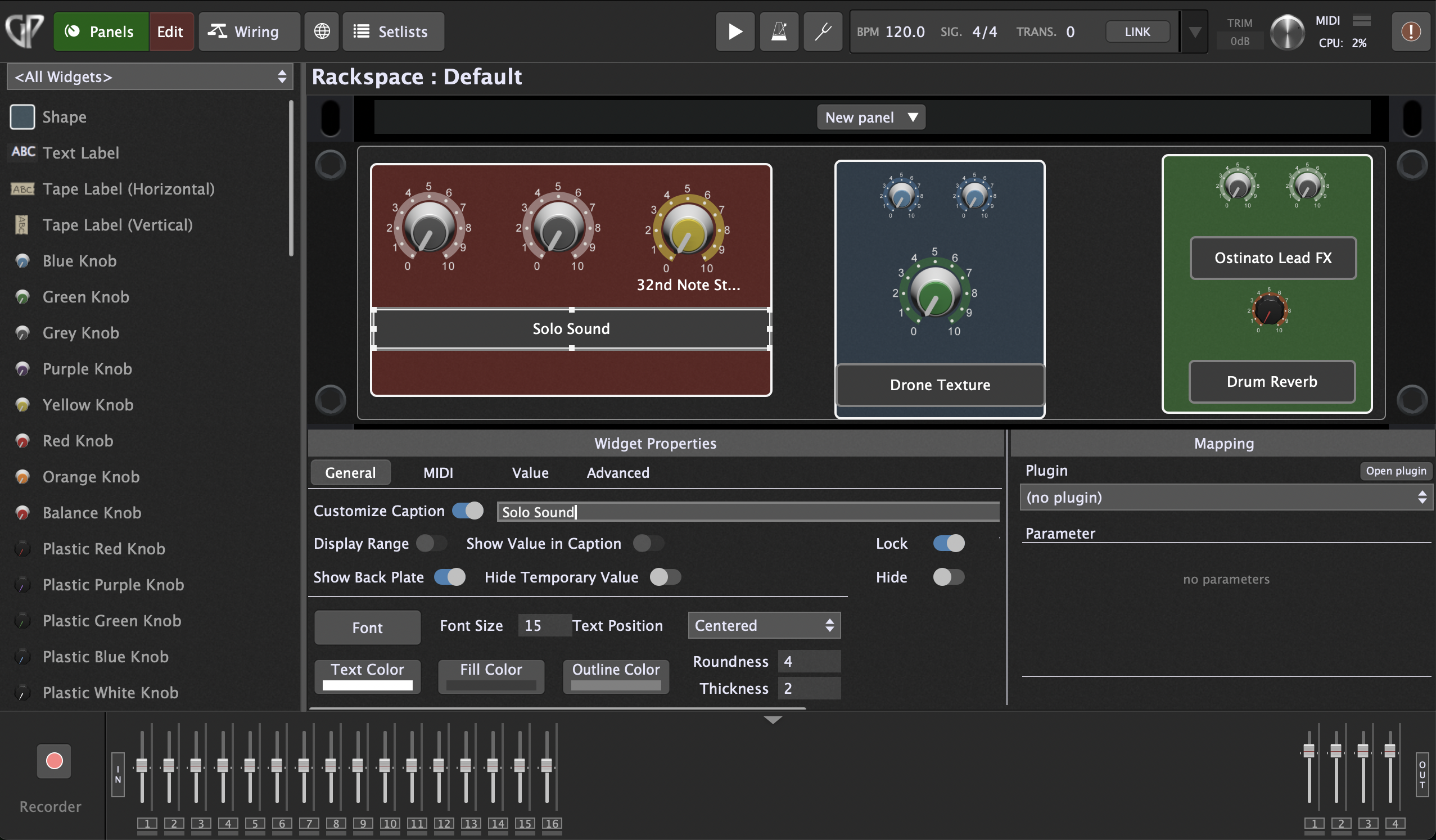
Numerous new widgets are included in Gig Performer - a new sustain pedal, plastic knobs, drum pads and more colored sliders. Shapes can be colored with different borders and fill colors and morphed from rectangular to circular. Your creativity is now the limit to creating fabulous front panels in Gig Performer.
Some plugins support a large number of outputs and they depend on the traditional channel strip to control how many ports should be available. When you only need a stereo pair, it is convenient not to have a large horizontal block. In Gig Performer, the number of available ports is controlled by the channel count override, which can be applied to individual plugins and will be remembered when the gigfile is reloaded or if the plugin is saved as a favorite.
Rather than a single audio length tail, Gig Performer 4 gives you the ability to control input muting and output fading separately. Input muting controls how much time it takes for audio input to be silenced when you leave the rackspace. Output fading controls how much time will be taken for audio to fade out when you leave the rackspace.
Instead of searching through menus of perhaps hundreds of plugins (you know who you are!), the Quick Plugin Finder makes it easy to find the plugin you need by simply typing partial strings. For example, as shown here, to find the Modartt Pianoteq 7 plugins, it's enough to type pia mod 7 (in any order, by the way) to restrict the list of available plugins to those matching your query. The Quick Plugin Finder also knows about manufacturers, presets and favorites.
Any entry field can be changed by either dragging your mouse (or finger) up or down, or by using the large popup touchpad where you can just tap on the squares to enter a value. The large popup keypad also does validation so you can't enter an invalid value. You can also just tap the BPM field to pop up a larger view where you can quickly change tempo, tranpose, trigger Tap Tempo and enable Ableton Link, the last allowing you to synchronize Gig Performer with any other application that also supports Ableton Link.
The tuner view makes it easy for guitarists to quickly check and adjust their tuning. You can toggle into the tuner view from any other view and toggle right back as soon as you're done. All output will be silenced automatically while you're in tuning mode. You can adjust the concert reference pitch from its default of 440 Hz to suit your own needs. The tuner view fills the entire screen so you can easily see it from a distance.
GP Script adds new language improvements such as multiple initialization sections, initialization with declarations and enhanced callbacks. The WidgetValueChanged callback now supports multiple widgets. Sysex messages are now built-in with numerous supporting functions. String array handling is much faster. Integer bit manipulation is now built-in. A new global GigScript allows incoming MIDI messages to be modified and redirected on the fly. It also allows you to define keyboard macros for your computer keyboard to control Gig Performer itself. For complete information, please review the GP Script Language Manual available through the Help menu.
Scriptlets make creating custom MIDI processors easy. You don't have to be a programmer to use them - you can just download scriptlets from our ever-growing collection on our website and drop them right into your rackspaces to use them. Use scriptlets for simple operations such as turning your single notes into chords, modifying, duplicating or converting one kind of message into another, automatic chord latching (AutoSustain), threshold detection, sysex manipulation... imagination is the limit.
Numerous other enhancements and optimizations serve to make Gig Performer 4 a superb platform for performing artists.
The Global Rackspace can receive audio from whatever rackspace is currently active. Instead of inserting effects in every rackspace, simply insert them once in the Global Rackspace and all your local rackspaces will have access to them. The Global Rackspace can also send audio to the currently active rackspace. So you can insert a looper that receives audio directly from your guitar (say) and then send the looped audio to different effects in different rackspaces. If a particular instrument such as a piano or organ is needed everywhere (or almost everywhere), put it in the Global Rackspace.
Gig Performer 4 provides a virtual view allowing you to spread out your blocks and connections to make them easier to see and manage, even if you have a very small screen. You can zoom in or out and you can use the Auto-Fit option to position your blocks to fit in the available space.
Click here to see the complete list of release notes for Gig Performer 4.5
Seamlessly integrate thousands of backing tracks into your gig files while preserving your precious RAM resources. The Streaming Audio File Player plugin, which supports multiple audio formats including MP3, WAV, OGG, and FLAC, lets you switch instantly from one song to another as needed, and, of course, it supports host automation for easy control via Gig Performer widgets. This new Player offers remarkable playback and intuitive control while your tracks are running.
This will close in 0 seconds

The Streaming Audio File Player allows you to insert markers in song tracks and add actions triggered during audio playback as each marker is reached.
.
New to Gig Performer? You can easily take advantage of numerous actions to control widgets, set captions, send out MIDI events and switch rackspaces or song parts. Advanced users can leverage Gig Performer’s proprietary GPScript programming language to trigger custom actions and functionality developed by 3rd parties using Gig Performer’s SDK.
This will close in 0 seconds
The Auto Sampler allows you to create a set of samples from your plugins that, if used together, would demand too much CPU to be practical for live performance. Alternatively, you can sample sounds from your external synths, eliminating the need to bring them to a show.
.
The image illustrates how we simultaneously create samples from three sources—two VST plugins, each followed by effects, and an external synthesizer. You can play the sounds manually from your keyboard to create the desired mix and then run the Auto Sampler to capture the results for individual notes. The Auto Sampler can also capture multiple velocities if desired. See this feature in action in this video.
This will close in 0 seconds

A feature often requested and now realized in Gig Performer 4.7 is radio groups, which makes it easy to define mutually exclusive parameters such as the Fast-Off-Slow choices for the well-known Leslie rotary sound. You can assign a radio group number to a collection of buttons and then click any button to turn it on while automatically turning off other buttons in the same radio group. Up to 99 radio button groups can be deployed. See this feature in action in this video.
This will close in 0 seconds
MIDI Finger Tap, previously available only by using GPScript, is now easily accessible via the MIDI File Player plugin. With this feature, you can playback MIDI files with multiple tracks sequentially by simply tapping a key (or even a foot pedal) to trigger the next note or chord. Each time you tap, the Player will step by a quarter or eighth note (or any duration chosen), and the MIDI events in that range will be triggered.
This keeps your performance in sync with the rest of the band while enjoying freedom from click tracks. With one hand liberated, you are then free to embellish melodies or play other essential parts. See this feature in action in this video.
This will close in 0 seconds

Having dozens, if not hundreds, of plugins at your disposal can open new avenues of creativity in performance. Still, these tools can easily become a cluttered mess if not managed properly. Gig Performer 4.7 provides improved plugin management, enabling keyword tagging for individual plugins and a filtering mechanism to find them instantly. Plugin collections, i.e., those used routinely in setups, can be added as “favorites,” which can then be recalled to quickly recreate sections of a system to streamline workflow with greater efficiency and organization.
This will close in 0 seconds
Gig Performer’s custom font support allows you to incorporate your favorite fonts to enhance readability and visual appeal, design front panels that resonate with their unique style, imitate the design of your favorite hardware tools, or create a look that quickly grabs your attention. Every glance at your workspace provides inspiration and a personal touch to your live performance experience. See this feature in action in this video.
This will close in 0 seconds
Gig Performer’s locked widgets feature prevents your widgets from being inadvertently altered by mouse clicks while allowing control via your MIDI device, bringing you peace of mind during preparation, rehearsal and performance. See this feature in action in this video.
This will close in 0 seconds
Quickly review your gig file’s plugin lineup, regardless of its scale, with the new Plugins In Use feature. You can easily view and export plugin names and formats for quick identification and seamlessly transition from old VSTs to upgraded alternatives with pinpoint accuracy. This enables you to have a clear view of plugin formats and to choose and monitor your tools in a highly informed manner, which is particularly important when working cross-platform.
This will close in 0 seconds
With new Multiple Tap Tempo algorithms, you can simply tap a key to achieve the perfect tempo, no matter the genre of music or personal expression of time. These algorithms work to align the system tempo or to shift effects, ensuring precision each time the tempo is adjusted and providing the ultimate companions for achieving correct tempos quickly.
This will close in 0 seconds
With Gig Performer’s new widgets, prepare to take your visual creativity to the next level. Now included is an expanded range of knob, fader, and slider styles, each destined to elevate front panel design. Let your imagination run wild as you design interfaces as captivating as your music.
This will close in 0 seconds
Efficiency is the cornerstone of creativity. Gig Performer’s workflow improvements are here to return time stolen doing tedious tasks to your creative process. Experience the convenience of seamless font and color copy/paste, swift mapping of multiple widgets to a single plugin with a single click, effortless wire deletion through backspace, and numerous enhancements that improve your workflow. See the release notes for a full list of new and updated features.
This will close in 0 seconds